What is Modernity?
The Metabolism of Techno-industrial society

H.Sapiens has remained anatomically continuous for 300,000 years, thus there have been approximately 12,000 generations. Of these, around 500 have lived since the agricultural revolution, and only 10 since the Industrial Revolution. Clearly, there have been two major accelerations in the history of our species. These accelerations have occurred in the realm of cultural evolution and in our capacity to cooperate on increasingly large and complex scales. This has enabled the development of more specialised forms of knowledge, to the point where not only are there no longer universal geniuses across all disciplines, but it is no longer possible to master even a single field in its entirety. Subjects such as biology and physics have grown so vast that comprehensive expertise in any one of them is beyond the reach of any individual. This evolution has contributed to the rise, and now the apparent decline, of nation states, as we find ourselves embedded in a complex, fragile and interdependent global system.
To put the brevity of these changes into perspective: if the entire 300,000-year story of H. sapiens were told in a 250-page book, the agricultural revolution would not begin until page 246. The Industrial Revolution would appear only in the final paragraph of the final page, less than a quarter of a single page devoted to the most radical transformation in how H. sapiens live, work and relate to one another. The scale of this acceleration becomes even more stark when viewed through the lens of population growth. For more than 99.9% of its existence, the population of H. sapiens remained under one billion. It took the full span of those 300,000 years to reach that milestone—finally crossing the one-billion mark around the year 1810. Yet in just the two centuries since then, the population has exploded more than eightfold. What once took hundreds of millennia now takes decades. We added the most recent billion in barely a dozen years. This is not a gentle curve, it is a vertical wall.
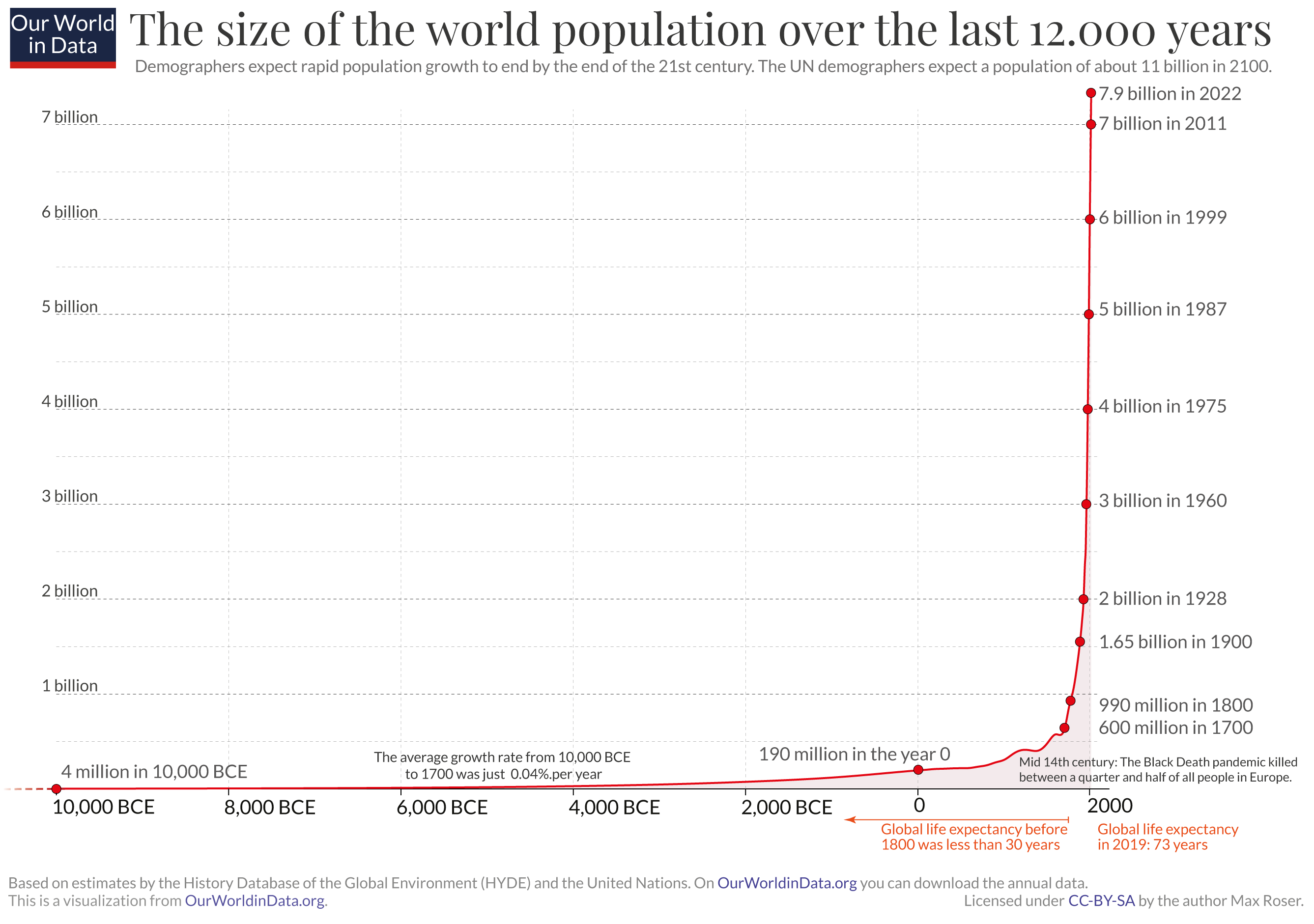
H. Sapiens is, at its core, an animal. And like all animals, when it discovers a niche in nature that it can successfully exploit, it tends towards exponential growth. This is not a conscious strategy but a biological imperative, hardwired into life itself. However, such growth cannot continue indefinitely. Sooner or later, it encounters negative feedback loops that act as natural checks. If it is a prey species, increasing numbers make it more visible and vulnerable to predators. If it is a predator, overexploitation of its prey leads to collapse and starvation. As population density rises, diseases spread more easily and more rapidly, often killing large numbers and reducing pressure on the ecosystem. Eventually, most species reach an equilibrium with the carrying capacity of their environment—a dynamic balance maintained by the interplay of food availability, space, competition, and disease. This equilibrium can be stable for long periods, but if environmental conditions change significantly or rapidly, the species may not adapt in time. In such cases, extinction often follows, without warning and without mercy.
H. sapiens, in both its hunter-gatherer and agricultural phases, never escaped the constraints of ecological and demographic feedback loops. These limitations are clearly evident in the archaeological and fossil records, as well as in historical accounts. Populations rose, but they also fell—often dramatically. For early agrarian societies, periodic and cyclical collapse was not an anomaly but a regular pattern, consistent with the predictions of Malthusian theory. As populations grew, food production struggled to keep pace. Sooner or later, rising pressures led to famine, disease and conflict. Entire states and civilisations fragmented or vanished, only for others to rise and repeat the cycle. The default trajectory for any society operating under conditions of exponential population growth and pre-industrial agricultural methods was a recurring crisis—what might be called the natural order of collapse. War, pestilence and hunger were constant threats, the many horsemen of many apocalypses.
What disrupted this long-standing pattern was the emergence of Modern Techno-Industrial (MTI) society. This was not merely a new phase in economic production or political organisation, but a radical departure from all previous modes of existence. It introduced entirely new forms of energy capture, technological innovation, and systems of knowledge production. Crucially, MTI society managed, at least temporarily, to decouple population growth from the harsh checks of nature. Scientific medicine blunted the impact of disease. Mechanised agriculture and synthetic fertilisers pushed back the spectre of famine. Industrial-scale warfare became more devastating, but also more restrained by political and technological means. For the first time in the species’ history, H. sapiens had constructed a system powerful enough to hold back the ancient forces of collapse. But whether that system is stable, sustainable, or survivable in the long term remains an open question.
Eddington famously remarked that out of all the laws of nature, if your theory contradicts thermodynamics, then it is not just flawed—it is absolutely hopeless. This was no overstatement. Thermodynamics is not merely a branch of physics; it is a foundational framework that governs the behaviour of all systems, from stars to engines to living organisms. Its laws are not easily bent, and certainly never broken.
The first law of thermodynamics states that energy cannot be created or destroyed, only transformed. This principle underpins all physical processes, including those within living systems. Every calorie consumed by H. sapiens, every ray of sunlight absorbed by a leaf, and every watt of electricity used by a machine must be accounted for. Nothing is gained without something being lost or changed.
The second law introduces the concept of entropy: in any closed system, disorder tends to increase over time. No process is perfectly efficient. There is always waste, heat lost, energy dissipated, structure degraded. This law defines the arrow of time and sets hard limits on the efficiency of energy use, from industrial machines to biological metabolism. It reminds us that complexity comes at a cost, and that all organised systems, including civilisations, must constantly fight against decay.
The third law states that as a system approaches absolute zero, the entropy of a perfect crystal approaches zero as well. While more abstract, this law reinforces the idea that absolute efficiency and perfect order are not achievable. In practical terms, it reminds us that no matter how advanced our technology becomes, there are fundamental physical limits that cannot be surpassed.
To these three, we might add a fourth: Kleiber’s law, a biological scaling law that describes how the metabolic rate of an animal scales to its body mass. Specifically, it shows that an organism’s energy consumption increases at a rate slower than its size, approximately to the 3/4 power. This has profound implications. It means that as H. sapiens scaled up its societies—from small tribes to sprawling MTI society—its collective metabolic footprint grew ever larger, but not linearly. The concentration of energy and resources in cities, factories and infrastructure leads to economies of scale, but also to new vulnerabilities. The same principles that govern the metabolism of a mouse or an elephant are at work in our global systems, and they come with their own constraints.

Together, these laws form a hard boundary around what is physically and biologically possible. They are not rules we invented, but conditions we discovered, conditions under which life, civilisation and even thought itself must operate. Any model of the future that ignores them is not merely optimistic, but delusional.
Every society has a metabolism. To build the pyramids, many ingenious labour-saving tactics were employed, demonstrating intelligence harnessed to serve the great pride of the elites. Yet at its core, the fundamental metabolism was simply the conversion of chemical energy into kinetic energy. Our energy ultimately comes from the food we consume, which in turn traces back to plants drawing power from the Sun. This is why, in a certain sense, the physiocrats were correct in asserting that the true source of value lies in the land. Labour and capital—workers and their machinery—require a constant flow of energy to avoid becoming nothing more than piles of scrap or lifeless bodies. When a farmer plants crops, he is, in effect, receiving a gift from nature itself.
Ilya Prigogine’s concept of a dissipative structure describes a system that maintains its organisation through the continuous flow and dissipation of energy. Unlike closed systems, which move inevitably towards disorder and equilibrium, dissipative structures are open systems that remain far from equilibrium by importing energy from their environment and releasing waste energy back into it. This flow allows them to maintain complexity, adapt to changes, and even evolve new forms of order. Crucially, such structures can only exist as long as the energy flow continues. Once the flow is interrupted, the structure begins to decay and collapse into disorder.
In biological terms, animals are clear examples of dissipative structures. An animal takes in energy in the form of food, uses it to fuel metabolism and maintain bodily functions, and releases waste heat and matter. This constant flow of energy is what allows it to remain alive, organised and responsive to its environment. If the energy supply is cut off, the animal cannot maintain its internal order and begins to break down.
Energy plays a central role in understanding evolution. Building on earlier insights from physicist Ludwig Boltzmann, mathematician Alfred Lotka proposed that evolutionary success depends on how effectively organisms and systems capture and use available energy from their environments. He argued that those which maximise the appropriation and efficient use of energy—also known as exergy—are more likely to survive and thrive. This idea was later refined by ecologist Howard Odum into the ‘maximum power principle’, which holds that natural selection favours systems that self-organise in ways that maximise energy intake and power output in support of maintenance, growth and reproduction. In essence, evolution does not simply favour the fittest in abstract terms, but those best adapted to harness and convert energy effectively. Systems that fail to do so are ultimately selected against.
The same principle can be applied to human civilisation. A city, for instance, is a highly complex and ordered structure that relies on massive flows of energy, materials and information to maintain itself. Food, fuel, electricity, clean water and waste removal are all parts of the energy and resource metabolism of a modern society. If these flows are disrupted or decline significantly, the structures built on them—economic, social and physical—begin to degrade. Civilisation, then, can be seen as a super-organism, a large-scale dissipative structure that exists in a constant state of energetic tension with its environment. Its survival depends on the continued availability of high-quality energy sources and the ability to manage the waste and disorder that come with them.
One of the fundamental differences between H. sapiens and other animals is our ability to consume exosomatic energy—that is, energy used outside our own bodies. While all animals rely on endosomatic energy, derived from the food they consume to power their metabolism and physical activity, H. sapiens developed the unique capacity to harness energy sources beyond the body. This includes the use of fire, the muscle power of domesticated animals, and eventually fossil fuels such as coal, oil and gas. This shift enabled us to extend our influence far beyond our biological limits, fuelling everything from agriculture and transport to industry and information systems.
MTI society is, in essence, the product of discovering how to harness first coal and then hydrocarbons. It is important to recognise that one dollar’s worth of energy is not directly equivalent to another dollar’s worth of GDP, because energy is a fundamental input to every action within an economy. We pay for the costs of extracting energy, but we do not pay for the environmental damage it causes, and we consistently undervalue the labour it provides our capital.
A human being can produce roughly 600 watt-hours of physical work in a day, enough to power an average computer for about three to six hours. A single barrel of oil, by contrast, contains around 700,000 usable watt-hours. That is the equivalent of approximately five years of continuous human labour. Today, the global economy is powered by the equivalent of around 100 billion of these fossil energy workers. They have no rights, require no wages, and demand no rest.
This invisible labour force, equivalent to half a trillion human workers each year, powers our tractors and combine harvesters, drives our lorries and global shipping fleets, fuels our high-temperature industrial processes, runs our mining operations, heats our homes, lights our cities, and sustains the continuous hum of machines and servers that modern life depends upon. This is before even considering the countless petrochemical derivatives that form the foundation of everything from plastics to fertilisers.
This is the source of the eightfold increase in population growth and the hundredfold expansion in economic output: a fourteen hundredfold rise in fossil fuel consumption. Fossil fuels are the lifeblood of our civilisation. This relationship holds true from first principles, but it is also strikingly evident in countless statistics. For example, oil consumption alone correlates with a country’s GDP at an R-squared value of 0.93, demonstrating a very strong and direct connection between energy use and economic activity:

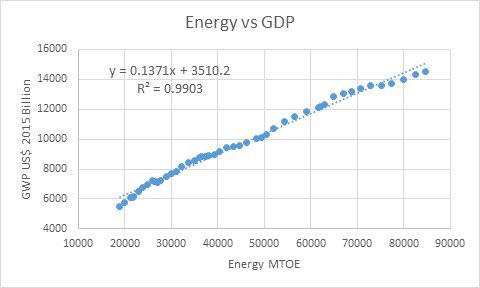
In Steve Keen’s upcoming book, he shares an excerpt preview on Substack that includes some outstanding graphs illustrating just how closely global economic output and energy use are linked, with change in growth mirroring change in energy use very closely and Growth and Energy use correlated at an R squared of 0.99:

Innovation is, of course, important—indeed vital—in how energy is utilised and made more efficient to support the growth of H. sapiens populations and prosperity. However, the true source of modern wealth and growth lies in the energy stored from the sun in fossil carbon. Its high power density, ease of transportation, and wide applicability make it irreplaceable by any other energy source currently available. Nothing is on the horizon to replace it as we currently rapidly move towards depletion as we extract it at a rate around ten million times faster than it was produced.
Further Reading:
[this discussion was deeply influenced by and recapitulates in essence many of the points made in this paper, which I feel obliged now to cite: Rees, W.E. The Human Ecology of Overshoot: Why a Major ‘Population Correction’ Is Inevitable. World 2023, 4, 509–527. https://doi.org/10.3390/world4030032
Great article thanks very much for the insight. Will go deeper into this